Learn Poker: Step-by-Step Guide for Beginners 2026
What is Poker and Why Everyone Plays Texas Hold'em
Poker is a family of card games where you compete not against the house, but against other players. The most popular variant is Texas Hold'em: this is what is played at the WSOP, the main world series of tournaments, and this is where you should start. The rules of Texas Hold'em can be learned in an evening, and you can perfect your game for a lifetime – this is the appeal of poker.
If you want to play poker online, you'll need a poker room (a website or app). If you want to practice first, you can play poker for free with play money chips or in freerolls. More on this below.
Poker Rules: How a Hand is Dealt
How to play poker from scratch if you've never held cards? Let's break down a standard Hold'em hand.
Blinds. Two players to the left of the button make mandatory bets. If you don't know what blinds are in poker, they are the "seed" of the pot: the small and big blind, which move around the table with each hand.
Pre-flop. Each player receives two hole cards and decides: fold, call, or raise.
Flop, Turn, River. Five community cards are dealt face up on the table in stages: first three (flop), then the turn, and finally the river. After each street, there's a round of betting.
Showdown. The best five-card hand wins. Or the player who forced everyone else to fold through betting – all the way to an all-in bet, all of your chips.
Study the positions at the poker table separately: button, blinds, early and late positions. Position is the first strategic concept that distinguishes an informed player from a novice: the later you act, the more information you have.
Poker Hand Rankings by Strength
Poker hand rankings are what you need to memorize before your first hand. Here they are, from highest to lowest:
# | Hand | Description |
|---|---|---|
1 | Royal Flush | Ten, Jack, Queen, King, Ace of the same suit |
2 | Straight Flush | Five cards in sequence, all of the same suit |
3 | Four of a Kind | Four cards of the same rank |
4 | Full House | Three of a kind and a pair |
5 | Flush | Five cards of the same suit, not in sequence |
6 | Straight | Five cards in sequence, not of the same suit |
7 | Three of a Kind (Set) | Three cards of the same rank |
8 | Two Pair | Two different pairs, e.g., two Kings and two Sixes |
9 | One Pair | Two cards of the same rank |
10 | High Card | No hand made – the highest card wins |
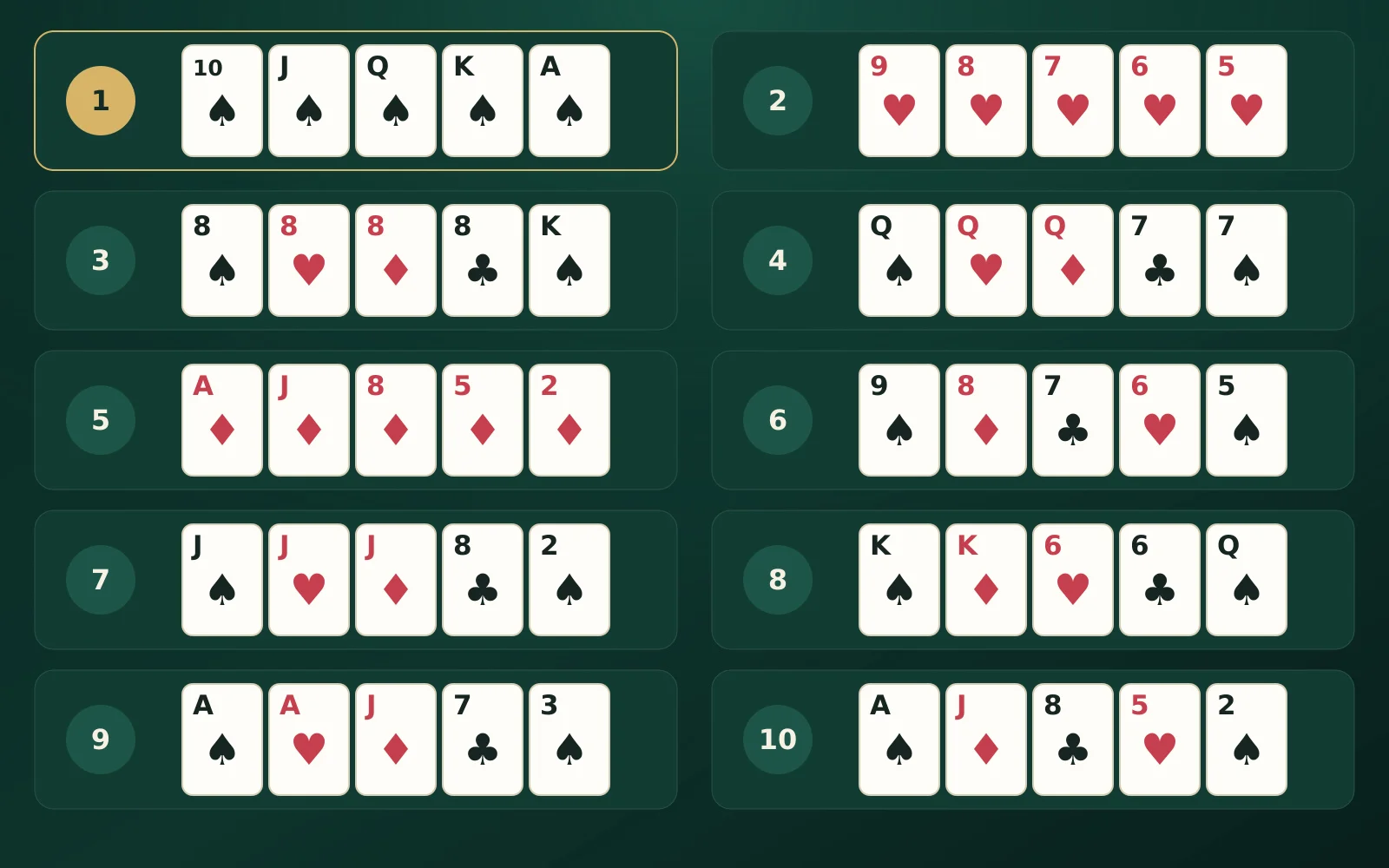
A common question from beginners is what beats what: a flush or a straight. A flush is higher. Remember this before you lose your first big pot, being confident of the opposite.
Two more terms that cause arguments at the table. The kicker is the "addon" to a hand: if both players have a pair of Aces, the one with the higher next card wins. A split pot is a situation where the hands are identical and the pot is divided equally.
💡 Save this table – a screenshot on your phone works perfectly as a cheat sheet for your first sessions.
Where to Play Poker Online: Choosing a Room
Once the rules are clear, the question arises – where to play poker online. Don't register at the first place you find. Here's what to look for:
Interface and support in your language. A room with a localized client and live support in a language you understand will save you a lot of nerves when you first contact them – especially if the issue concerns money.
Soft fields. Poker rooms for beginners are those with many recreational players and low minimum limits, not those where you'll be met by regulars with trackers.
Payout speed. Look for lists of rooms with fast withdrawals and read reviews.
A full breakdown with current conditions is in our section "Best Poker Rooms 2026: Ratings and Comparison". Here's the main point: for starting out, convenience and reliability are more important than the bonus amount.
Bonuses: What a Beginner Can Actually Get
Almost every room offers a first deposit bonus – usually 100% of the deposit amount, which is unlocked as you generate rake. There's also a no-deposit bonus for registration: a small amount of money or tournament tickets just for creating an account – ideal for trying out real money play without risk.
A separate topic is poker freerolls: free tournaments with real prizes. For a beginner, this is the best bridge between playing with chips and playing for money: you risk nothing but get used to making real decisions. We collect the schedule in our freeroll calendar.
Important: Before activating any bonus, read how to clear the bonus – the clearing conditions (rake, deadlines, game restrictions) vary drastically.
How to Start: Step-by-Step Instructions
Step 1. Install the Client
Choose your platform: you can download poker for your computer (Windows/Mac), install an app on your Android or iPhone – major rooms have all versions, and often a web client to play in your browser without downloading.
Step 2. Register and Verify
Verification at a poker room (KYC) is a standard procedure: a photo of your document and proof of address. Complete it immediately, without waiting for your first withdrawal – this way you'll avoid your funds being frozen at the cashier at the most inconvenient moment.
Step 3. Make a Deposit
How to deposit into your poker room account: card, e-wallets, and in some countries – local methods and cryptocurrency. The minimum deposit for most rooms is $10–20, and that's enough to start. Don't deposit more than you're prepared to lose during the learning process.
Step 4. Start with Micro-Limits
Your goal for the first few months is not to earn money, but to learn not to lose. Play at the lowest stakes, understand what rake is (the room's commission on each pot) and how to get a part of it back through rakeback.
Step 5. Withdraw Correctly
Withdrawing money from a poker room is usually done using the same method as your deposit. Withdrawal times range from a couple of hours for e-wallets to several days for cards. If something goes wrong, we have a separate guide on what to do if you can't withdraw money.
Beginner Strategy: The Minimum You Should Start With
A complete poker strategy is the subject of our separate hub, but three things you need from day one:
Starting hand charts. A novice's biggest mistake is playing too many hands. Starting hand charts in poker tell you which hands to play from each position. Find a basic chart for your format, keep it in front of you, and follow it mechanically for the first 10,000 hands.
Outs and pot odds. Outs in poker are the cards that will improve your hand; pot odds are the ratio of the bet to the pot. The rule of 2 and 4 allows you to calculate your chances in your head in seconds. This is all the poker math you need at micro-limits.
Bankroll management. Bankroll management in poker is the rules for managing your gaming money: for example, not sitting at a cash game table if you have less than 30 buy-ins for that limit. It is bankroll discipline, not brilliant bluffs, that distinguishes those who stay in the game.
And about psychology: sooner or later you will encounter tilt – a state where, after a bad hand, you start playing on emotions. The ability to get up from the table on time is a skill no less important than knowing hand rankings. Typical beginner poker mistakes – limping with weak hands, chasing every flush, and playing above your bankroll – are 90% a consequence of emotions, not ignorance.