Omaha Poker Rules (PLO): How to Play Poker from Scratch
On the board are five community cards, four of which are hearts. You hold the Ace of hearts. In Hold'em, this is enough: your Ace plus four cards from the board – five hearts, a flush, and the pot is almost certainly yours. In Omaha, you show your hand and win nothing.
This happens to almost everyone who comes to Omaha from Hold'em. And almost no one understands what happened at that moment, because the rules of Pot Limit Omaha look deceptively familiar: the same hand rankings, the same streets, the same blinds, the same dealer button. There are only two differences from Hold'em. But one of them turns the game so much that for the first few weeks you have to check your hand manually, like a schoolchild checking a solved problem.
Let's figure out what these differences are and why that Ace of hearts turned out to be a useless card.
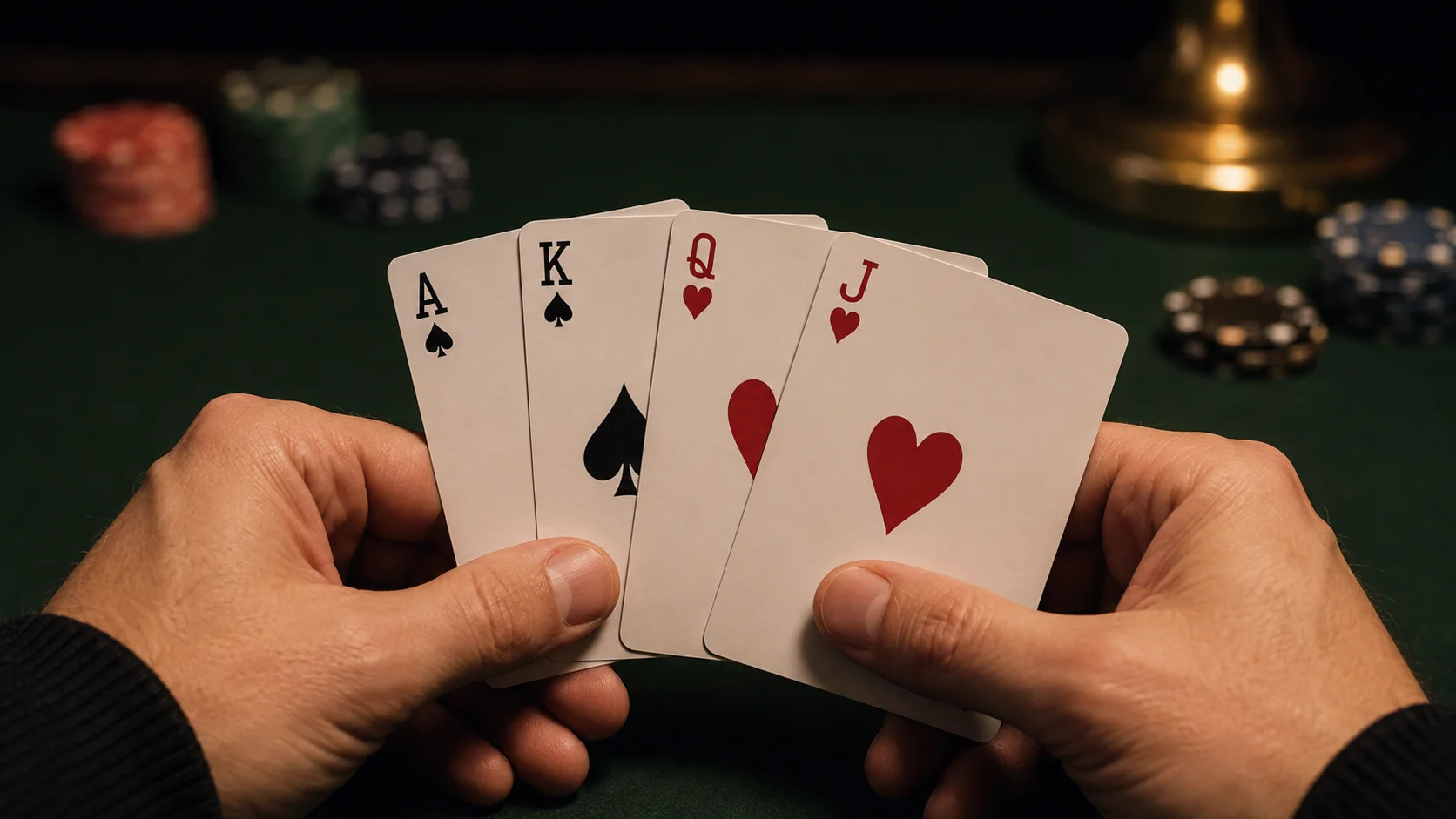
What Omaha Consists Of
The good news is: you already know half the rules. Blinds, preflop, flop, turn, river, showdown, dealer button, betting order – all of this works exactly the same as in Texas Hold'em. No need to reread.
There are two differences, and both fit into one sentence. You are dealt four cards instead of two, and you cannot bet more than what is in the pot.
Hence the name: Omaha is about four cards, Pot-Limit is about limiting bets to the size of the pot. Together, this becomes PLO, and it is in this form that the discipline exists in almost all rooms. You'll only find No-Limit Omaha in private games.
Four cards is not "twice as many options." It's twice as many cards for everyone at the table, which means everyone's hands are stronger. This might sound abstract for now, but it will become very concrete later.
The Rule That Breaks Everything
Here it is: in Omaha, you must form a hand using exactly two of your cards and exactly three cards from the board. Not one, not three, not four. Strictly two.
There is no flexibility here. The room will form your hand according to this rule, even if you think you have something stronger. Let's return to the hand from the beginning of the article.
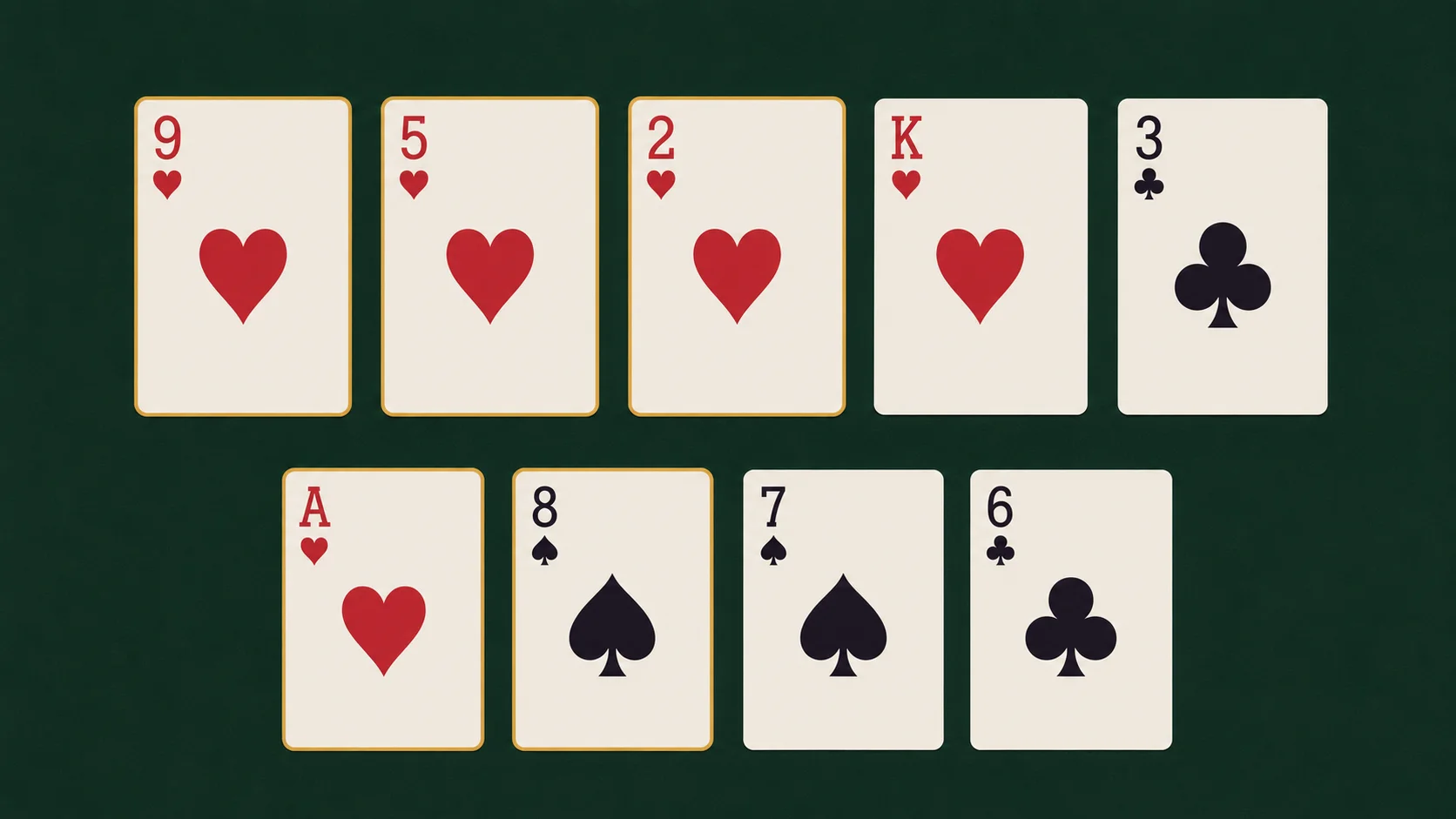
Board: 9♥️ 5♥️ 2♥️ K♥️ 3♣️ Your Hand: A♥️ 8♠️ 7♠️ 6♣️
There are four hearts on the board, and you have an Ace of hearts in your hand. In Hold'em, you would take your Ace, add four cards from the board, and get five hearts – a flush, and the highest one. This is not allowed in Omaha: you must use exactly two cards from your hand, and you only have one heart. There is no flush at all. And while you're betting the river, someone with two small hearts quietly takes the pot.
Now the same board, but a different hand.
Board: K♠️ Q♠️ 7♠️ 4♦️ 2♣️ Your Hand: A♠️ J♠️ 9♦️ 3♣️
Here there are three spades on the board and two in your hand – exactly the right amount. Let's count: two from you plus three from the board, a total of five spades. There is a flush, and it is the highest.
And if you had only one spade in your hand, there would be no flush in either Omaha or Hold'em: four cards of the same suit are not yet a combination. The arithmetic is simple and never changes. A flush is always exactly five cards of the same suit. The only difference is where they come from: in Hold'em, any way you like; in Omaha, strictly two from your hand and three from the board.
This rule also works in reverse. If there is a completed straight on the board, 5♦️ 6♣️ 7♥️ 8♠️ 9♦️, in Hold'em you would split the pot with anyone who had a straight. In Omaha, you don't play the board: your two cards are mandatory. With a hand like 10♣️ K♦️ 3♠️ 2♥️, one ten won't save you – to make a straight, you need a ten and a jack together.
A simple trick helps to get used to this: read your hand not as four cards, but as six pairs. Four cards give exactly six combinations of two, and you are essentially playing six small Hold'em hands at once. This is how everyone who plays PLO seriously looks at it.
How Much You Can Bet
The second difference is softer but requires getting used to. In No-Limit Hold'em, you can move all your stack, meaning all your chips, at any time. In Omaha, the betting limit is the size of the pot.
This is calculated in three steps. See how much you need to call. Mentally add that amount to the pot. What you get is the maximum you can raise on top of the call.
For example, with blinds of 1/2, there is 3 in the pot. You are first to act: you call 2, the pot becomes 5, you raise by 5 – for a total bet of 7. That's why experienced players say "opened to the pot" and bet exactly 7, even though it seems to a newcomer that the pot is 6.
On the post-flop, the logic is the same. The pot is 100, your opponent bet 50. You call 50, the pot becomes 200, you raise by 200 – your bet is 250.
You won't have to calculate this in your head every time; the "Pot" button is available in any room. But it's worth memorizing typical open bets:
Blinds | Pot before your turn | Maximum Open Bet |
|---|---|---|
0.5 / 1 | 1.5 | 3.5 |
1 / 2 | 3 | 7 |
2 / 5 | 7 | 17 |
5 / 10 | 15 | 35 |
25 / 50 | 75 | 175 |
Why understand this if the program calculates it? Because the pot in PLO grows like an avalanche. A pot-bet on the flop, a pot-bet on the turn – and suddenly you're playing for your whole stack, even though no one ever said "all-in." You have to plan the hand three streets ahead, and to do that, you need to feel how the pot will turn into after each bet.
The Combinations Are The Same, But Their Value Is Different
The card combinations in Omaha by rank are completely the same as in Hold'em – from high card to royal flush. You don't need to learn a new table.
What changes is the value of these combinations. You will often encounter the word "nuts" – this is the name for the best possible hand given the board. The reason is simple. Each opponent has four cards, meaning six possible combinations instead of one. The chances that at least someone at the table has a strong hand increase significantly.
Combination | In Hold'em | In Pot-Limit Omaha |
|---|---|---|
Two Pair | Often wins | Rarely holds up in a big pot |
Set | Very strong hand | Average, easily beaten |
Straight | Strong hand | Average, often not the nuts |
Non-nut Flush | Usually wins | Regularly loses to a higher flush |
Full House | Almost always nuts | Good, but not a guarantee |
This entire table can be summarized in one phrase that is repeated ad nauseam in PLO: play for the nuts. As soon as you build a big pot with a hand that is not the best possible hand, you are playing against the odds. An Ace-high flush on a board where a King-high flush is possible is almost always second best and almost always results in a lost stack.
What It Looks Like in a Real Hand
Let's go through one from start to finish, it will be clearer.
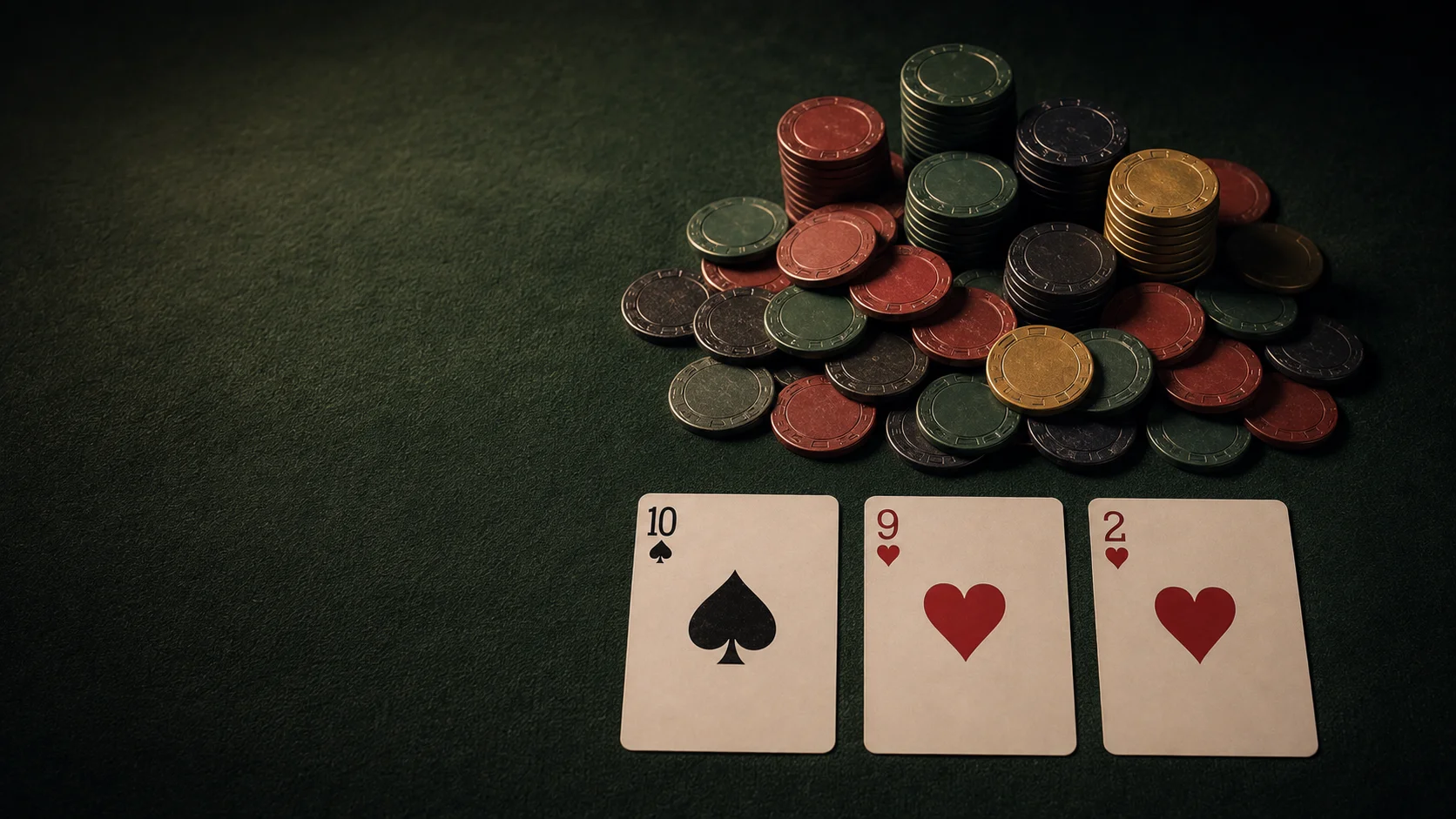
Blinds are 1/2, six players, everyone has 200. You are on the button – the dealer position, the most advantageous at the table – with A♥️ K♥️ Q♦️ J♣️ in your hand – high connected cards plus suited, you can play this confidently. The middle position opens to the pot, you call, and the big blind also calls. The pot is 22.
The flop comes 10♠️ 9♥️ 2♥️.
Here it's important to count the Omaha way, not the Hold'em way. In Hold'em, you'd say: I have a King, Queen, and Jack, any card will complete a straight. This is not allowed in Omaha – you take exactly three cards from the board, and there are only two useful ones so far, a ten and a nine. The deuce doesn't fit into any straight.
Therefore, a straight will appear when the third suitable card comes to the table. There are four of them: an eight will give Q-J-10-9-8, and a Jack, Queen, or King will give K-Q-J-10-9. Each time, exactly two cards are taken from your hand, as required. A draw – an incomplete hand missing a card – is excellent here, you just need to count it differently than you are used to.
However, with a flush, it's the opposite. An Ace and King of hearts in your hand plus two hearts on the board – this is a true nut flush draw, and it's much more valuable than what you might have imagined.
Your opponent bets 15, you call. The pot is 52.
Turn: 7♥️. The third heart on the board – you have a nut flush. Your opponent checks, you bet 40, they call. The pot is 132.
The river 4♣️ changes nothing. Your opponent checks again, you bet 100, they call and show 10♦️ 10♣️ K♠️ 6♦️ – a set of tens, made on the flop.
Remember this hand for two reasons. A set, which in Hold'em almost guarantees a win, turned out to be the second-best hand here – your opponent played it like a monster and paid for three streets. And the win didn't come from the draw that seemed most important on the flop: the straight never materialized, but the flush, which you barely looked at, worked out.
What Hands to Play
Four cards create the feeling that you can play almost anything. This feeling is deceptive, and it comes at a high cost.
A good hand in Omaha is one where the cards work together. A♠️ A♥️ K♠️ Q♥️ – the standard: Aces, two suits, a high connector. J♠️ 10♠️ 9♥️ 8♥️ – a two-suited rundown, makes the most straights and plays better than many "strong" hands. A♦️ K♦️ Q♣️ J♣️ and K♠️ K♦️ J♠️ 10♦️ also confidently go into play.
Here are hands that look solid but aren't. A♠️ A♥️ 7♦️ 2♣️ – Aces with two useless cards attached; you're essentially playing two cards against four. A♠️ A♥️ A♦️ K♣️ looks monstrously strong, but three Aces in your hand mean there are almost no other Aces left in the deck – you've killed your own outs. K♥️ K♠️ 4♦️ 2♣️ regularly turns out to be the second-best hand, which is the worst possible position in poker. And 9♠️ 4♥️ 7♦️ 2♣️ is just four random cards.
An extra card that doesn't connect with the others is called a "kicker" or "dangler." Holding one means you're playing a three-card hand against a full four-card hand.
And one more thing that Hold'em habits don't prepare you for. In Hold'em, AA beats a random hand about 85% of the time, so with Aces, you can almost always go forward without thinking. This doesn't work in Omaha: the gap between the best starting hand and a decent one is much smaller, and against a connected two-suited hand, the advantage of Aces shrinks to a few percent. In multi-way pots, it often disappears completely. Don't take my word for it – run a couple of hands through an equity calculator that shows the probability of each hand winning. This will be the most useful hour in your learning.
Variations
The classic is PLO4, four cards. This is usually just called Omaha, and it's best to start with it: the rules are simpler, and there are more players in the rooms.
PLO5 and PLO6 deal five and six cards. The rule of two cards from your hand doesn't go away, but the number of combinations increases, the hands are stronger on average, and the variance increases so much that these tables can be quite uncomfortable without experience.
Omaha Hi-Lo splits the pot between the high and low hands. The low hand is counted if it consists of five cards valued eight or lower. The subtlety that everyone confuses at first: for the high and low hands, you can use different pairs of cards from your four.
There is also Big O – a five-card hi-lo version, but you'll mainly encounter it in live games in the USA.
What Most Often Leads to Losing Money
Overestimating Aces. AA with two random cards against three opponents is not the hand to inflate the pot preflop for.
Playing non-nut straights and flushes. Lower straights are especially painful: a board of 9-10-J, you have 7-8, you've made a straight – and anyone with Q-K will take your stack.
Forgetting the two-card rule. Even those who have understood everything and nodded still automatically imagine a flush with one suited card. Check your hand consciously for at least the first month.
Underestimating position. In Omaha, it's worth more than in Hold'em: pots grow faster, and each decision costs more. From early positions, you need to ruthlessly cut your range.
Coming with a Hold'em bankroll. The variance in PLO is higher, the downswings are longer and deeper. The cushion that was enough in Hold'em won't be enough here – and this is not a matter of skill, but a matter of arithmetic.
How Omaha Differs from Hold'em
Parameter | Texas Hold'em | Pot-Limit Omaha |
|---|---|---|
Cards in Hand | 2 | 4 |
Use of Hand Cards | Any number | Exactly two |
Betting Format | Usually No-Limit | Pot-Limit |
Starting Hand Strength Range | Large | Small |
Average Strength of Winning Hand | Lower | Significantly higher |
Variance | Moderate | High |
Role of Position | Important | Critical |
What Next
You now know the rules, and practice will take care of the rest.
Sit at the micro-stakes and for the first few sessions, verbally go through which two cards you are using on each street. This technique sounds childish, but it's exactly what separates a person who has understood Omaha from someone who has simply brought their Hold'em reflexes to it. Simultaneously, run your hands through an equity calculator: the discrepancy between how you evaluate hand strength and how things actually stand is usually sobering.
Where to start. For your first steps in Omaha, CoinPoker and Americas Cardroom are good choices. Both have active PLO tables at the lowest limits, and for a beginner, this is more important than any bonuses: you need to learn where there are people to play with, but the loss per session is measured in a couple of dollars.
CoinPoker operates on cryptocurrency – money goes in and out in minutes, without bank intermediaries and long verifications. Americas Cardroom offers something else: it has stable traffic in Omaha, tables fill up not only during evening prime time, and you can sit down to play almost anytime of the day.
When the two-card rule becomes automatic and you stop seeing non-existent flushes, you can move on to PLO strategy – starting hand selection, playing from position, and pot building.